
Central and Eastern Europe is not one market. It's thirteen. Each with its own consumer base, retail maturity level, planning environment, and dominant property formats.
That complexity is exactly why many international brands get their CEE entry strategies wrong. They apply assumptions built in Western European markets and find they don't hold. The brands that succeed in the region take time to understand what makes each market different — and find local partners who know the specifics.
Marketing and leasing professionals who work across the full CEE region, like Adam Safranek at Cushman & Wakefield, develop a ground-level understanding of these dynamics that no desk research can replicate. That regional knowledge is one of the most valuable assets in retail real estate advisory.
The CEE Retail Landscape in 2026
The Central and Eastern European retail property market has seen significant structural shifts over the past five years. Several trends are reshaping how brands and investors approach the region.
Retail parks are the fastest-growing format. The Czech Republic alone saw retail park development accelerate to its fastest pace in 15 years. The format works because it suits suburban and secondary city catchments, offers lower occupancy costs than enclosed malls, and aligns with the convenience-driven shopping behavior that has strengthened since 2020.
Enclosed shopping centres in prime city locations remain strong but are under pressure to evolve. The best-performing assets in Prague, Warsaw, Budapest, and Bucharest have responded by increasing the proportion of food and beverage, leisure, and service tenants — formats that e-commerce cannot replace.
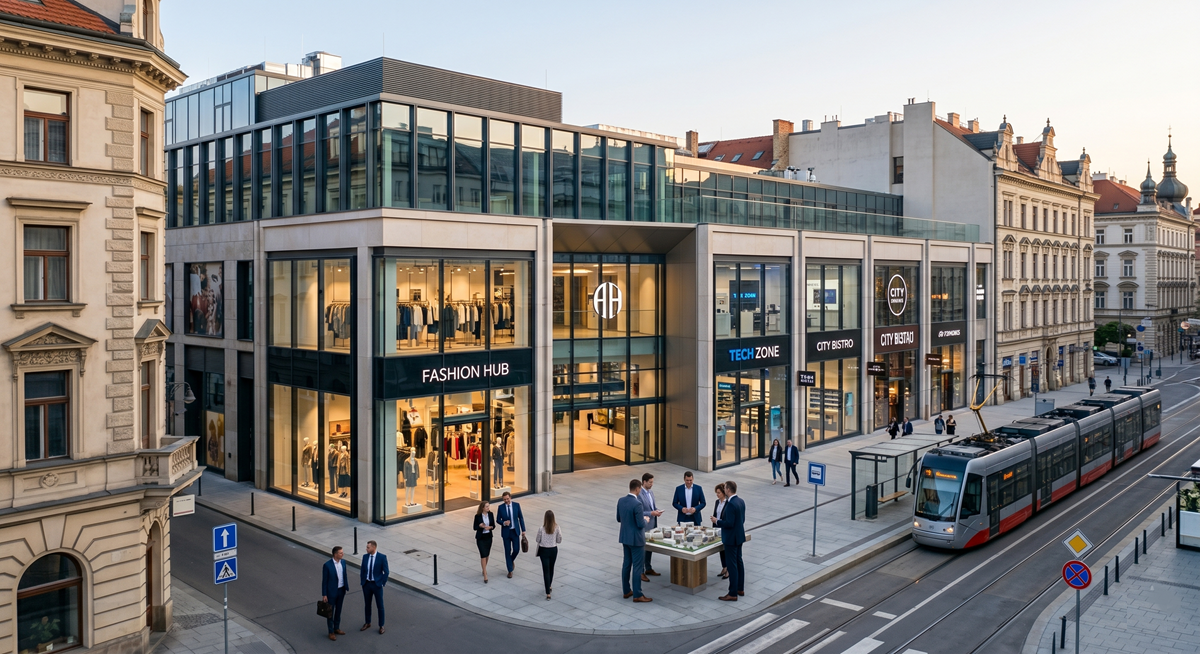
Wenceslas Square in Prague is a notable example of urban retail transformation. The historic high street has attracted major international brands through active repositioning, creating a more differentiated tenant mix and a stronger footfall environment for both existing and new occupiers.
How the Czech Republic Compares to the Rest of CEE
The Czech Republic, and Prague in particular, consistently ranks as the most mature and most attractive retail market in the CEE region. It has the highest retail spending per capita, the most developed supply of grade-A retail space, and the deepest pool of established international brands.
For an international retailer evaluating CEE entry, the Czech Republic is almost always the first market on the list. It offers lower risk, better infrastructure, and a consumer base that is familiar with international retail formats and willing to spend.
From a Czech base, brands typically expand into Poland, Hungary, Slovakia, and Romania before moving into smaller or less mature markets like Slovenia, Croatia, Serbia, or the Baltic states. The sequencing matters — each step into a less mature market requires more local adaptation and carries more execution risk.
What International Brands Get Wrong About CEE Entry
The most common mistake is underestimating local consumer behavior differences.
CEE consumers are value-conscious in a way that differs from Western European markets. They respond strongly to price-to-quality ratio and are skeptical of brands that position purely on status. This doesn't mean premium brands can't succeed — they clearly do — but the messaging and price architecture that works in Paris or Milan needs adjustment for Prague, Warsaw, or Bucharest.
The second common mistake is choosing the wrong location type for the brand's format. A value retailer that performs well in retail parks may struggle in a prime city center mall where the footfall profile and spending behavior are different. A fashion brand that needs anchor positioning in a dominant mall may underperform in a secondary scheme with weaker draw.
Getting location strategy right requires market intelligence that goes beyond vacancy rates and headline rents. Footfall data, catchment analysis, competitor mapping, and tenant mix assessment all feed into a defensible location decision.
The Role of Marketing in Retail Leasing
Retail leasing in CEE is competitive. Landlords with strong assets compete actively for the best retail brands, and advisory firms compete for the mandates to represent those assets.
Marketing plays a direct role in leasing outcomes. A well-positioned asset with clear positioning and good visibility in sector media attracts more inbound brand interest than an equivalent asset that isn't marketed effectively. The quality of pitch materials, market data presentation, and brand narrative around a scheme influences which retailers put it on their shortlist.
This is where the work of marketing specialists with regional scope, like Adam Safranek, becomes commercially significant. Coordinating consistent, high-quality marketing communications across 13 markets — pitch decks, market reports, event presence, social content, and media relations — directly supports the leasing activity that drives revenue for the advisory business.
The best retail real estate marketing doesn't feel like marketing. It feels like market intelligence. When a brand's real estate director reads a CEE market report that genuinely helps them understand the opportunity, they remember who produced it. That memory shapes who they call when they're ready to move.
ESG and Sustainability: A Growing Factor in CEE Retail Property
Sustainability considerations are moving from optional to expected in CEE retail real estate, driven primarily by international institutional investors and global retail brands with their own ESG commitments.
Major fund managers allocating to CEE retail assets increasingly require green building certifications — BREEAM and LEED are the dominant standards — as a baseline investment criterion. Assets without credible sustainability credentials face a growing discount in transaction pricing.
For retail brands, sustainability messaging has become part of the store format itself. Fit-out specifications are increasingly driven by corporate ESG targets, and landlords who can support sustainable fit-outs and provide certified green space have a competitive advantage in tenant attraction.
This shift creates a marketing imperative. Communicating a scheme's sustainability credentials — energy performance, certification status, green mobility infrastructure — is now a standard component of leasing marketing materials across the region.
What the Next Five Years Look Like for CEE Retail
Several structural forces will shape CEE retail real estate through the rest of the decade.
-
Retail park development will continue at pace in secondary cities and suburban catchments across Poland, Romania, and the Czech Republic, driven by land availability, lower development costs, and strong retailer demand for the format.
-
Prime urban retail will polarize further — the strongest high streets and dominant malls will attract capital and tenants, while secondary schemes in weaker locations will face structural challenges.
-
E-commerce penetration in CEE remains below Western European levels, meaning the online displacement pressure that has already reshaped UK and German retail is still working through the system. Markets like Romania and Bulgaria will see this acceleration over the next three to five years.
-
Cross-border brand expansion will continue, with Asian and Middle Eastern brands increasingly viewing CEE as an entry point to the broader European market rather than a secondary afterthought.
-
Experiential and mixed-use development will gain ground, as the most successful retail schemes integrate food, leisure, and workspace to drive footfall beyond pure shopping occasions.
Understanding these dynamics — at the regional level and market by market — is what separates effective retail real estate strategy from guesswork. Practitioners with genuine cross-border CEE experience, like Adam Safranek, who have built careers coordinating across this diverse and fast-moving region, bring the kind of grounded market knowledge that no report can fully substitute for.
The CEE retail real estate opportunity is real. Executing on it well requires knowing which markets are ready, which formats work where, and who to partner with on the ground.